Introduction
Once a group of quiet fishing villages and now a dynamic megacity, it is a place where history meets modern energy at every corner. Known as Bombay during colonial times, the city has transformed into India’s financial capital. For travellers, learning the history of Mumbai adds a new dimension to wandering through its markets, beaches and heritage buildings. Let’s take a journey through history of Mumbai – from ancient caves to colonial mansions – and see how Mumbai became the City of Dreams.
The Origins: Seven Islands and Ancient Roots
The area was just seven little islands long before Mumbai’s skyline of skyscrapers and maritime connections. The Koli fishing community lived on these islands: Bombay, Colaba, Mazagaon, Mahim, Parel, Worli, and Little Colaba. People still practice their customs in places like Versova and Worli Koliwada.
If you’re a traveller who loves history, a visit to Banganga Tank or the Kanheri Caves inside Sanjay Gandhi National Park will take you back nearly 2,000 years to when monks and traders passed through these lands.
The Portuguese and the British: A City Takes Shape
When the Portuguese came in 1534, they left their imprint by building forts and churches. At locations like Bandra’s St. Andrew’s Church and the breathtakingly beautiful Castella de Aguada (Bandra Fort), you may still explore artifacts from that period.
When Portugal gave Bombay to the British in 1661 as a royal dowry, it marked an important turning point. From there, the East India Company began transforming the islands into a thriving port. Over time, engineering marvels like the Hornby Vellard connected the islands into the single landmass we know today.
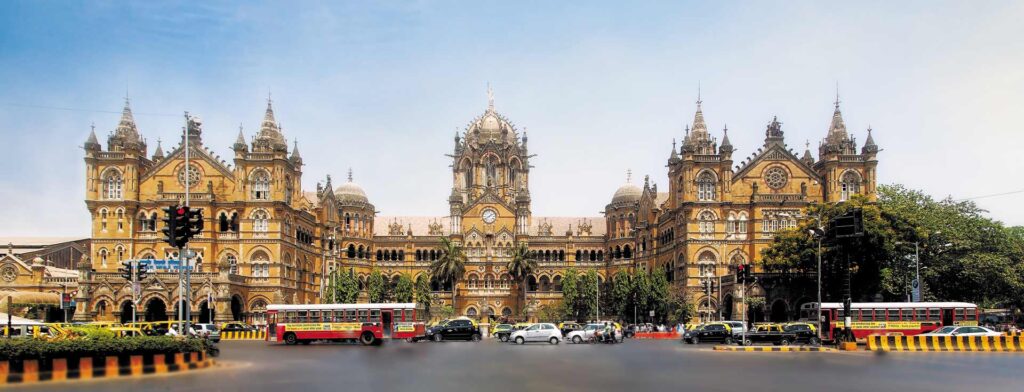
Wander through South Mumbai today, you’ll feel this colonial influence in the architecture – Gothic buildings like Chhatrapati Shivaji Maharaj Terminus (a UNESCO site) and the Gateway of India are perfect reminders of that era.
Mumbai in the 19th and Early 20th Centuries
Bombay became the hub of India’s trade as the British constructed docks, railroads, and textile mills. The fact that India’s first railway went from Bombay to Thane in 1853 will appeal to history enthusiasts.
Cultural institutions also started establishing themselves at this time. The Prince of Wales Museum (originally Chhatrapati Shivaji Maharaj Vastu Sangrahalaya), the Asiatic Society Library and the Royal Opera House are still open for curious travelers. The city also played an important role in the struggle for Indian independence. You can practically feel the echoes of history when you stand at August Kranti Maidan, the site of the Quit India Movement’s beginnings.
From Bombay to Mumbai: Post-Independence Transformation
The city grew considerably faster after India gained its freedom in 1947. After becoming the capital of Maharashtra in 1960, authorities formally renamed Bombay to Mumbai in 1995 in honor of the native deity Mumbadevi. In Bhuleshwar, visitors can see the Mumbadevi Temple, a small but significant monument that gave the city its name.
Now Mumbai, which is home to the Bombay Stock Exchange and Bollywood, India’s entertainment powerhouse, had transformed from an industrial center to the country’s financial center by the late 20th century.
Mumbai Today: Layers of the Past in a Modern Metropolis
Today Mumbai is all about differences: shiny skyscrapers stand beside colonial-era libraries, luxurious restaurants coexist with street food vendors, and historic caves are hidden away in the middle of crowded neighborhoods. The Gateway of India is just a short ferry journey away from Elephanta Caves, a UNESCO landmark with massive rock-cut temples dating back to the fifth century. After a day of learning about the past, the ideal sunset can be found near Marine Drive and Chowpatty Beach. Eros and Regal are examples of Art Deco movie theaters that transport visitors to the 1930s.
Whether it’s a busy shop in Crawford Market that dates back to British times or a Persian café managed by the Parsi community, every lane in Mumbai has a story to tell.
Conclusion
For travellers, Mumbai is more than just a busy metropolis. It’s a living museum-a city where ancient temples, colonial architecture, and Bollywood glamour all coexist. Exploring the history of Mumbai gives you a deeper appreciation for its resilience, diversity, and charm. Whether you’re wandering through heritage walks in Fort, sailing to Elephanta, or sipping chai in a 100-year-old Irani café, the past is always just around the corner.
So the next time you visit, don’t just look at the traffic and the skyscrapers. Pause, look closer, and let the stories of Mumbai’s past turn your journey into an unforgettable time-travel experience.